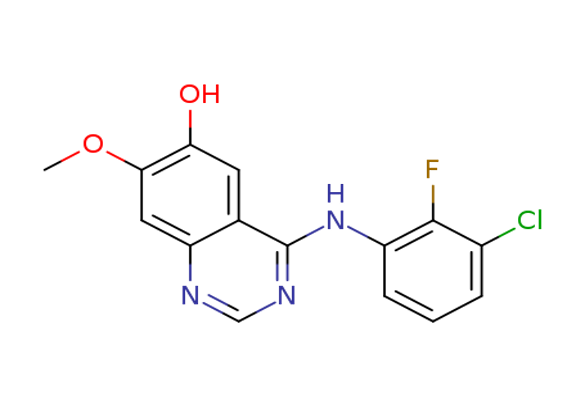
4-(3-Chloro-2-fluoroanilino)-6-hydroxy-7-methoxyquinazoline
Product Specifications
- CAS
- 612501-52-7
- MF
- C15H11ClFN3O2
- Appearance
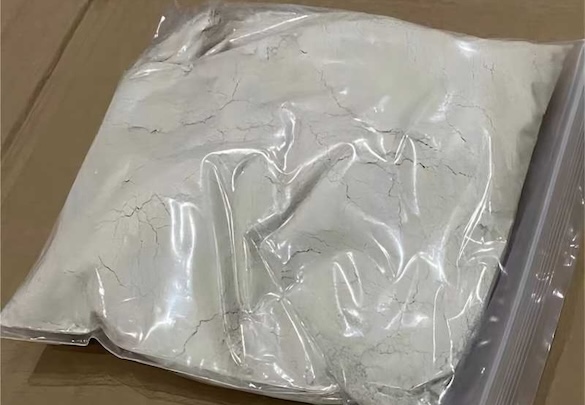
- white solid
- Synonym(s)
- 4-(3-chloro-2-fluorophenylamino)-7-methoxyquinazolin-6-ol; 6-Quinazolinol, 4-[(3-chloro-2-fluorophenyl)amino]-7-methoxy-
- Shipping
- ambient temperature
- Storage
- ambient temperature
4-(3-Chloro-2-fluoroanilino)-6-hydroxy-7-methoxyquinazoline denotes CAS 612501-52-7 and formula C15H11ClFN3O2. PubChem returns one compound, CID 57476868, titled 4-((3-Chloro-2-fluorophenyl)amino)-7-methoxyquinazolin-6-ol. The Rlavie wording is listed as an official synonym. Hydroxy versus quinazolinol wording and anilino versus phenylamino wording therefore describe the same substituted quinazoline graph.
SMILES COC1=C(C=C2C(=C1)N=CN=C2NC3=C(C(=CC=C3)Cl)F)O joins the anilino nitrogen to quinazoline position 4. It also places methoxy at position 7, hydroxyl at position 6, and fluorine next to chlorine on the phenyl ring. PubChem reports InChIKey VZBZUFGPXJGXNJ-UHFFFAOYSA-N, consistent with the complete page InChI. Formula alone cannot resolve these four substituent positions, making the structural strings decisive.
For CAS 612501-52-7, inspect the 3-chloro-2-fluorophenyl orientation and its nitrogen bridge when comparing a structure file with CID 57476868. The methoxy and hydroxy groups must occupy their stated neighboring quinazoline atoms rather than a swapped arrangement. The anilino nitrogen, not a direct carbon-carbon bond, connects the two aromatic systems in the validated entry uniquely and unambiguously. Matching the long SMILES provides a detailed connection test, and the InChIKey gives an independent whole-graph checkpoint. This identity set distinguishes the entry from related anilinoquinazolines that differ by one locant or substituent.