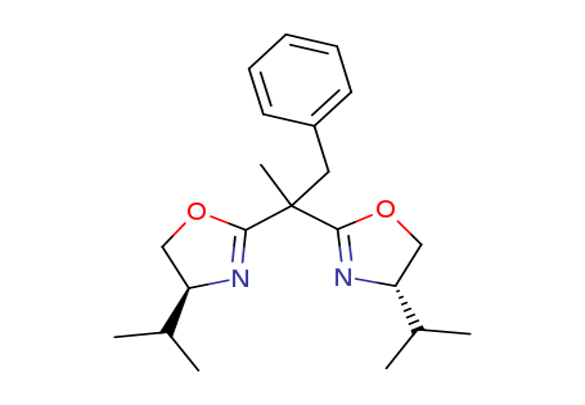
(4S,4'S)-2,2'-(1-Phenylpropane-2,2-diyl)bis(4-isopropyl-4,5-dihydrooxazole)
Product Specifications
- CAS
- 698350-53-7
- MF
- C21H30N2O2
- Appearance
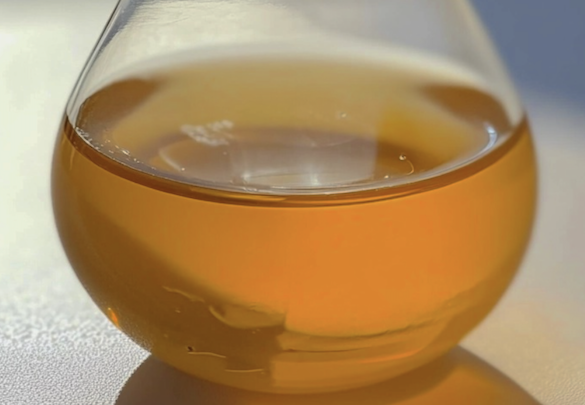
- yellow liquid
- Synonym(s)
- Oxazole, 2,2'-(1-methyl-2-phenylethylidene)bis[4,5-dihydro-4-(1-methylethyl)-, (4S,4'S)-
- Shipping
- ambient temperature
- Storage
- 2-8°C
(4S,4'S)-2,2'-(1-Phenylpropane-2,2-diyl)bis(4-isopropyl-4,5-dihydrooxazole) is identified by CAS 698350-53-7 and formula C21H30N2O2. The CAS resolves to one PubChem compound, CID 25265875, with molecular weight 342.5. PubChem records isomeric SMILES CC(C)[C@H]1COC(=N1)C(C)(CC2=CC=CC=C2)C3=N[C@H](CO3)C(C)C and InChIKey BBFBTUSLSAFMKW-QZTJIDSGSA-N for this configured graph.
Two 4,5-dihydrooxazole rings each contribute one nitrogen and one oxygen, and each bears an isopropyl group at position 4. Both ring centers have the `S` configuration specified by `(4S,4'S)`. Their 2 positions connect through the quaternary carbon of a 1-phenylpropane-2,2-diyl unit; the graph shows its phenyl-bearing methylene and methyl substituent. The prime marks distinguish corresponding positions on the paired rings. Removing them or either stereochemical descriptor would make the name less exact even though the molecular formula stayed C21H30N2O2.
For a configuration-controlled Rlavie inquiry, send the full name, CAS 698350-53-7, and the requested quantity together with a chiral MOL or SDF structure file. Compare the submission with PubChem CID 25265875, its isomeric SMILES, and InChIKey BBFBTUSLSAFMKW-QZTJIDSGSA-N before request-specific information is reviewed. The graph check should preserve both `S` centers, both 4-isopropyl substituents, and the central phenylpropane-derived bridge. An unconfigured drawing or a shortened “bis(isopropyl oxazoline)” phrase cannot distinguish this stereoisomer from alternatives sharing the same atom count and connectivity. This distinction remains essential for any graph-level comparison.